In this article we calculate when a cargo bike is more interesting for business than a van. You can read which costs you save, which subsidies are available and for which entrepreneurs the switch is most worthwhile. At the end you will know exactly whether a cargo bike suits your business.
Free delivery in NL and BE
Tested best in the Netherlands & Belgium with 8.5 and 8.2 by Fietstest.nl, Het AD and HLN
Bakfiets business: when does the switch pay off for entrepreneurs?
You'll find this in the article
- Why more and more entrepreneurs are discovering the cargo bike
- The cost of a van under the microscope
- Bakfiets business: what does it actually cost?
- Subsidies and tax benefits for the business cargo bike
- Zero-emission zones: the deadline approaches
- For which entrepreneurs does the switch pay off?
- The practice: combining van and cargo bike
- The math: when will you earn back the cargo bike?
- Tips for switching to a business cargo bike
- Getting started with your business cargo bike
- Frequently Asked Questions
Why more and more entrepreneurs are discovering the cargo bike
Using the cargo bike for business is becoming increasingly popular among Dutch entrepreneurs. And that's not surprising. Since January 2025, more than 30 cities in the Netherlands have introduced a zero-emission zone. This means that you can no longer simply enter the city center with a polluting delivery van. For many business owners, this is the time to take a critical look at their fleet. Is that van still the best choice? Or is it worth switching to an electric cargo bike?
In this article we calculate when a cargo bike is more interesting for business than a van. You can read which costs you save, which subsidies are available and for which entrepreneurs the switch is most worthwhile. At the end you will know exactly whether a cargo bike suits your business.
The cost of a van under the microscope
Before you can determine whether a cargo bike is the better choice for business, you need to know what a van will actually cost you. Many business owners greatly underestimate this amount. They mainly look at fuel and forget about everything else.
What does a van cost per month?
An average diesel van will soon cost you €600 to €900 per month. This amount is made up of several items. You have fuel costs averaging €150 to €250 per month, depending on your mileage. A delivery van consumes about 1 liter of diesel every 10 to 14 kilometers. At 1,500 kilometers per month and a diesel price of €1.70 per liter, you come to about €170 in fuel.
Then you have the fixed costs. Insurance for a van is between €80 and €150 per month, depending on the coverage and your claim-free years. Road tax for a van will cost you about €50 to €100 per month, depending on its weight and the province where you live. And then there's depreciation. A new €35,000 van depreciates an average of €400 to €500 per month over five years.
Maintenance and repairs will cost you an average of €100 to €150 per month if you set aside a buffer. Think about servicing, tires, brakes and unexpected repairs. Add to that parking costs, especially in cities, and you'll soon be spending an extra €50 to €150 per month.
Want to learn more about smart ways to replace your van? Then check out our blog on sustainable mobility solutions.
Hidden costs you overlook
In addition to direct costs, there are hidden costs that you often forget. Consider the time you spend looking for parking. In busy inner cities, you quickly spend 15 to 30 minutes a day parking alone. That's productive time you're losing.
Traffic jams also cost you money. On average, an entrepreneur in the Randstad conurbation spends 45 minutes a day in traffic jams. You can't bill for that time. And then there are the fines. A €100 parking fine is easily earned. Drive into an environmental zone by mistake? Then you pay €250 or more.
Driving a cargo bike for business solves many of these problems. You park where you want, drive through traffic jams and don't have to deal with environmental zones.
Bakfiets business: what does it actually cost?
Now that you know what a van costs, it's time to look at the cost of a cargo bike business. The difference is bigger than you think.
Purchase cost of a business cargo bike
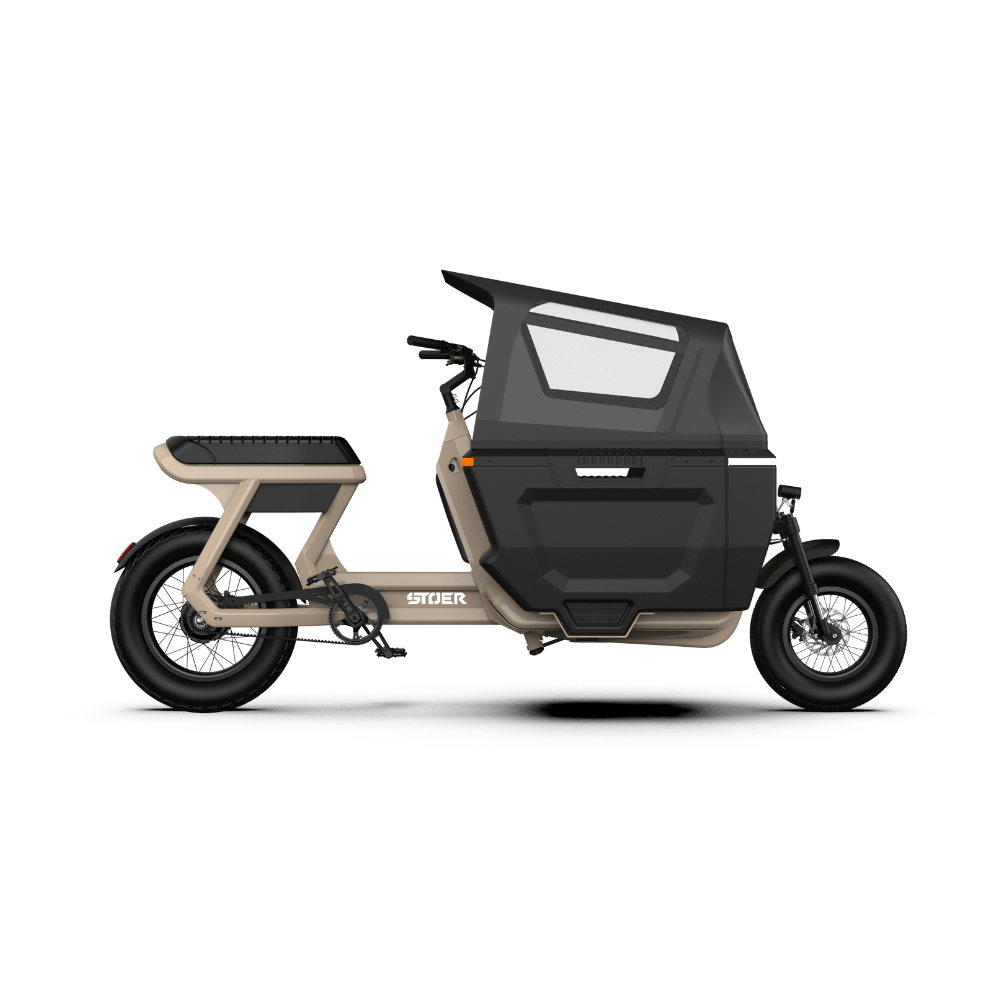
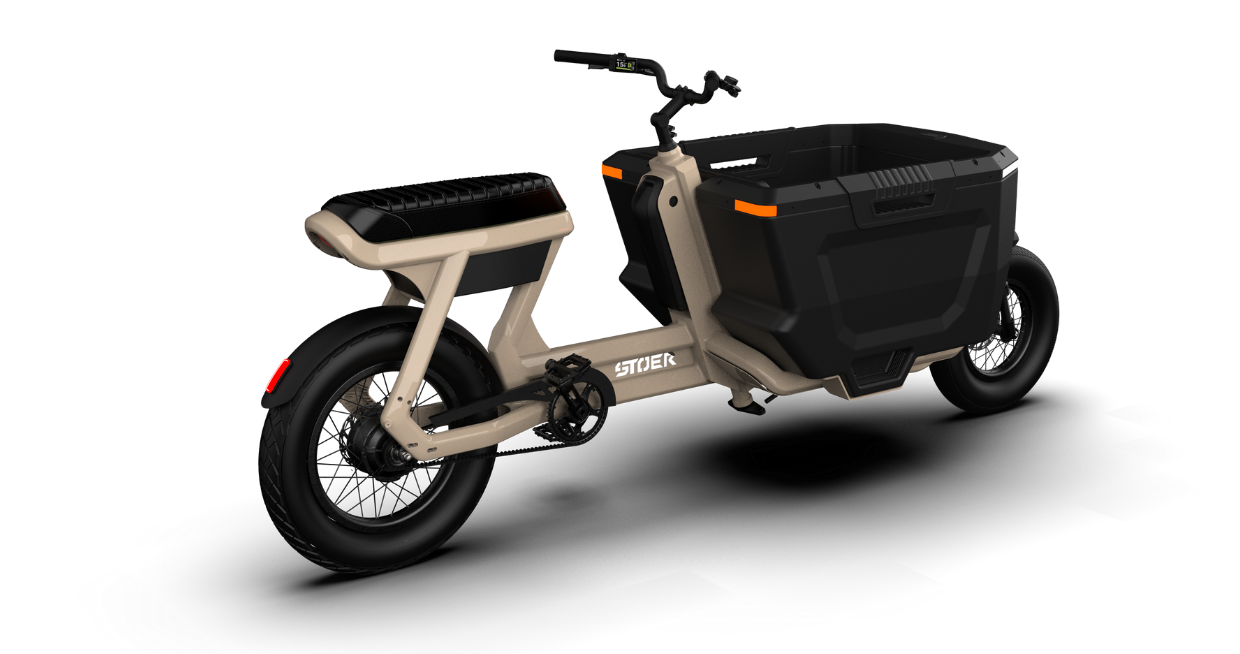
A professional electric cargo bike costs between €4,000 and €10,000, depending on the model and specifications. The STOER CargoX Business for example, costs from €6,495. This is a hefty investment, but a fraction of what a new van costs.
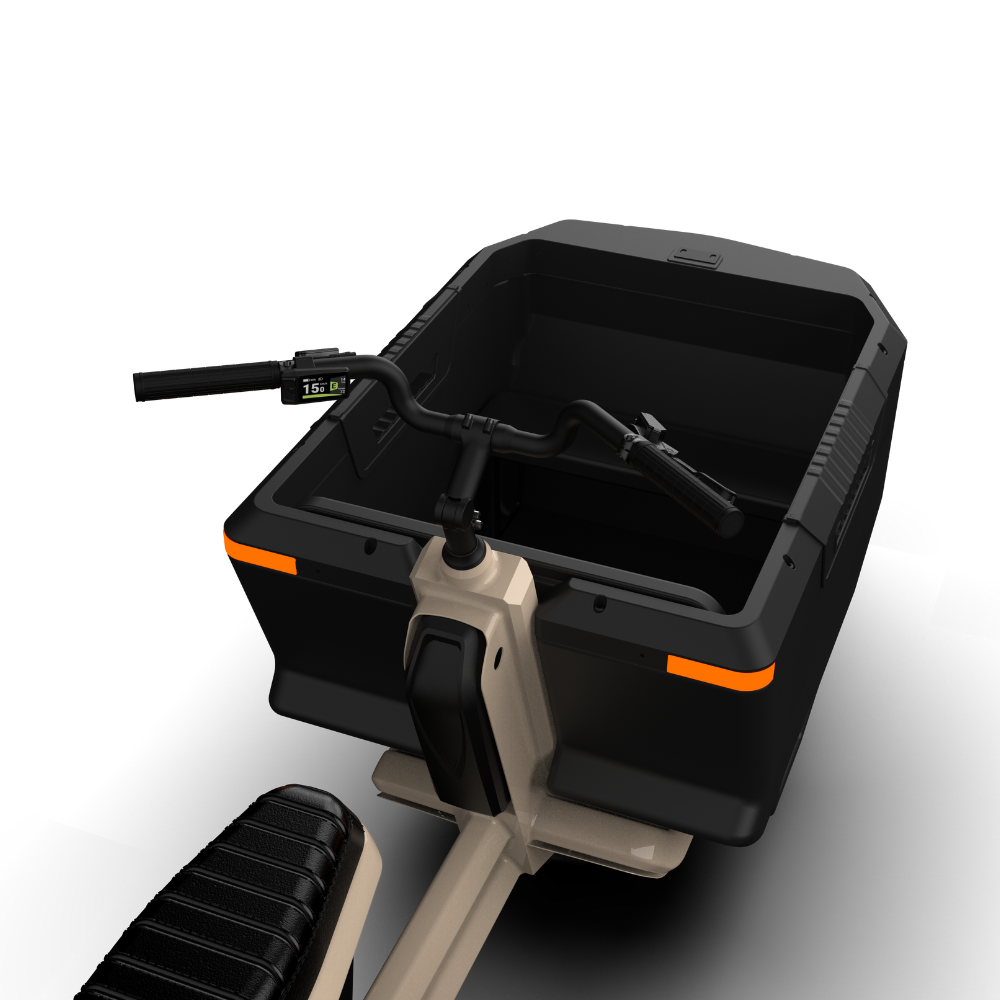
The CargoX has a load capacity of 150 kilograms and a 100-by-70-centimeter bin. The 960Wh battery gives you a range of 60 to 100 kilometers per charge. That's more than enough for a day's delivery around town. The Bafang motor with 92Nm of torque helps you move forward effortlessly, even with a full charge.
A key advantage of the CargoX is the Gates CDX belt drive. Unlike a traditional chain, a belt requires no maintenance. You don't have to lubricate and the belt lasts three to five times longer than a chain. That saves you time and money.
Monthly cost of a cargo bike
The monthly cost of a cargo bike business is a lot lower than that of a van. Let's go through the most important items.
Electricity for charging will cost you about €5 to €15 per month. A full 960Wh battery will cost you less than €0.30 at an electricity price of €0.30 per kWh. If you charge the battery twenty times a month, you pay €6 per month for "fuel." Compare that to €170 for diesel.
Insurance for an electric cargo bike will cost you €10 to €30 per month. STOER Bikes offers a special insurance to with three years of new value coverage and no deductible for theft. Road tax you don't pay for a bicycle. And parking fees? Those no longer exist.
Maintenance on a belt-driven cargo bike is minimal. Count on €50 to €100 per year for a service. That's €4 to €8 per month. Depreciation is also lower. With a purchase price of €6,495 and a lifespan of ten years, you will write off €54 per month.
Add it all up and you're at €80 to €120 per month for a cargo bike business. That's a savings of €500 to €800 per month compared to a van.
Subsidies and tax benefits for the business cargo bike
The government encourages sustainable transportation with various schemes. If you buy a cargo bike for business, you can benefit substantially.
MIA and VAMIL: additional deductions for entrepreneurs
The Environmental Investment Allowance (MIA) and the Arbitrary Depreciation of Environmental Investments (VAMIL) are interesting schemes for entrepreneurs. With the MIA you get up to 45% extra investment deduction on top of your normal depreciation. This applies to electric cargo bikes from €4,000.
VAMIL allows you to randomly write off 75% of the purchase cost in the year you want. That gives you flexibility in your tax planning. If you combine both schemes, the taxman indirectly pays for your cargo bike.
Suppose you buy a €6,495 electric cargo bike. Half of this is eligible for MIA and VAMIL. In the highest tax bracket, this gives you a net benefit of over €1,500. That already makes the effective purchase price a lot lower.
Small-scale investment deduction (KIA)
In addition to MIA and VAMIL, you can also take advantage of the Small Scale Investment Deduction. As an entrepreneur, you may deduct 28% of your total investments, provided you meet the conditions. For a €6,495 cargo bike, that's another nearly €1,820 in deductions.
The KIA applies regardless of whether you invest in a bicycle, machine or other asset. The only thing you need to pay attention to is the total investment amount per year. Check the current conditions on the website of the Rijksdienst voor Ondernemend Nederland.
Want to learn more about the business benefits of electric cycling? Then also read our blog about the benefits of belt drive.
Zero-emission zones: the deadline approaches
From January 2025, more than 30 zero-emission zones will be active in the Netherlands. This has major implications for entrepreneurs working in inner cities.
Which cities have zero-emission zones?
Large cities like Amsterdam, Rotterdam, The Hague, Utrecht and Eindhoven all have zero-emission zones. But smaller cities like Zwolle, Assen, Leiden and Delft are also participating. Chances are that you, as an entrepreneur, will be in one or more of these cities.
In a zero-emission zone, only zero-emission vehicles are allowed to operate. That means electric, hydrogen or walking. Your diesel bus is no longer welcome. Transitional regulations do apply. Vans with emission class Euro 6 may still enter the zones until 2028 or 2029, depending on the registration date.
But don't wait too long. From 2030, all vehicles in zero-emission zones must be zero-emission. If you buy a new diesel bus now, soon you won't be able to take it into town.
Why a cargo bike is the perfect solution
By definition, an electric cargo bike is zero-emission. You need no exemption, no permit, no registration. You just bike into the zone. In fact, you bike everywhere a bicycle is allowed. Those are places a van never goes.
Think pedestrian zones, narrow streets and squares. With a cargo bike business you deliver right to the door. No hassle with loading and unloading, no fines, no stress. And you're often faster than with a van because you're not stuck in traffic.
"The cargo bike is the ideal solution for last-mile delivery," says Thomas of STOER Bikes. "In the inner city, you are simply faster and more flexible with a cargo bike than with any other vehicle."
"We have been riding a Stoer bicycle for a year now without any problems. Even the battery capacity has not deteriorated. And when you then see other brands where after a year the rust marks are visible I am glad I spent a little more and now have a bike made entirely of aluminum. And this one stays really neat!!!"

What are the main conclusions about the weight difference between drive systems?

"Purchased a STOER Bike last year after trying several fatbikes. STOER is by far the best! Still very much enjoy my purchase. In addition, the service is top notch!"

"The bike is perfect for people with long legs. Sitting comfort is perfect for long distances."

For which entrepreneurs does the switch pay off?
A cargo bike business is not the best choice for everyone. For some business owners it's a golden opportunity, for others not practical. Let's see for whom the switch pays off.
Ideal industries for the business cargo bike
Delivery services and couriers benefit most from a cargo bike. Think of package deliverers, meal delivery drivers and mail carriers. They make many short trips around town and have relatively light loads. The cargo bike is ideal for this.
Installers and mechanics are another interesting group. Plumbers, electricians and central heating mechanics often drive to downtown addresses for minor repairs. Their tools fit easily into a cargo bike. And they no longer have to search for parking.
Florists, caterers and hospitality suppliers are also suitable candidates. They deliver products downtown and benefit from the flexibility of a cargo bike. The same goes for cleaning companies, home care organizations and mobile hairdressers.
View the STOER CargoX and find out if this cargo bike fits your business.
When is a van better anyway?
A cargo bike business is not suitable if you are transporting heavy loads. The maximum payload of the CargoX is 150 kilograms. If you regularly transport loads of 200 kilograms or more, a van is more practical.
A cargo van is also better for long distances. A cargo bike has a range of 60 to 100 kilometers per charge. If you need to travel 150 kilometers or more daily, a cargo bike is not useful. Although, of course, you can take an extra battery with you.
Finally, weather plays a role. With a cargo bike, you are more exposed to rain, wind and cold. While there are canopies and rain shelters available, it is still less comfortable than an enclosed van. For some business owners, this is a dealbreaker.
The practice: combining van and cargo bike
Many business owners choose not one or the other, but a combination. They use the van for long trips and heavy loads. And they use the cargo bike for deliveries around town.
The hub model for smart entrepreneurs
The hub model is gaining popularity. You drive a van or truck to a point on the outskirts of town. From there, you grab a cargo bike for the final miles. They also call this last-mile delivery.
This model is already used by large delivery companies, but it also works for smaller entrepreneurs. You combine the best of both worlds. The efficiency of a van for long distances and the flexibility of a cargo bike in the city.
Some cities are actively facilitating this with city hubs. These are locations where you can transfer goods from truck to cargo bike. Check with your municipality about the possibilities.
Making your fleet smart
Look critically at your trips. What percentage of your mileage is in the city? How many of your loads are lighter than 150 kilograms? If much of your work is in the city with relatively light loads, it pays to add a cargo bike to your fleet.
You don't have to sell your van right away. Start with a cargo bike business for your urban trips. See how you like it and calculate how much you'll save. You may discover that you need that van much less than you thought.
Read more about how other entrepreneurs are making the switch in our blog section.

The math: when will you earn back the cargo bike?
Let's do concrete math. When will you have a business return on the investment in a cargo bike?
A practical example
Suppose you are a plumber and drive to customers in the city five days a week. Your van costs you €750 a month in fuel, insurance, road tax, depreciation and maintenance. Not counting parking fees and fines.
You buy a STOER CargoX for €6,495. After deducting MIA, VAMIL and KIA, you effectively pay about €4,000. Your monthly cost for the cargo bike is €100 per month. That's a savings of €650 per month.
You'll have earned back the cargo bike in six months. After that, you save €650 per month, or €7,800 per year. Over the life of ten years, you'll save nearly €78,000. Not to mention the time you'll save by not sitting in traffic jams.
The payback period by scenario
The payback period depends on your situation. Do you drive around town a lot and use the cargo bike daily? Then you will earn it back in three to six months. Do you use it a few times a week? Then it will take six to 12 months. Do you keep your van for long trips? Then the savings are smaller, but still substantial.
Do the math on your own situation. Add up your current van costs. Estimate how many trips you can make with a cargo bike. Calculate the savings per month. And divide the purchase price by the monthly savings. That way you'll know exactly when the investment has paid off.
Tips for switching to a business cargo bike
Are you seriously considering buying a cargo bike for business? If so, we have a few practical tips for you.
Take a test drive
Before you buy, you need to ride. A cargo bike steers differently than a regular bike. Especially with a full load, you have to get used to the weight and width. Therefore, always take a test ride before making a decision.
At STOER Bikes you can get a test drive request. So you can experience for yourself how the CargoX drives and whether it suits your work. The dealers will be happy to advise you about the possibilities.
Check subsidies in advance
Apply for the subsidies before you buy the cargo bike. For MIA and VAMIL, you must report the investment to the Rijksdienst voor Ondernemend Nederland within three months of purchase. If you miss that deadline, you miss the benefit.
Get advice from your bookkeeper or accountant. They know exactly which regulations apply to you and how to make the best use of them. The investment in good advice quickly pays for itself.
Consider security
An electric cargo bike is a valuable investment. Therefore, make sure you have good security. The STOER CargoX comes standard with a PIN code immobilizer and built-in GPS tracking. This makes it a lot harder for thieves.
Also invest in a good lock. An ART-2 certified lock is the minimum. And park your cargo bike inside or under a shed whenever possible. View the accessories from STOER Bikes for suitable locks and other security options.
Getting started with your business cargo bike
Choosing to replace your van with a cargo bike is a big step. But it is also a logical step for many business owners. Costs are lower, subsidies are favorable and zero-emission zones almost force you to take action.
Start with an honest analysis of your current situation. How much does your van really cost? How many of your trips could you make with a cargo bike? And what will the switch give you in terms of time, money and convenience?
The math in this article will help you get started. But the best way to find out if a cargo bike is right for you is to try one. Schedule a test ride, get advice from a dealer and make an informed decision.
Using the cargo bike for business is not only good for your wallet. It is also good for the environment, livability in the city and your own health. And these are benefits you can't express in euros.
Frequently Asked Questions
How much can I load into a business cargo bike?
The STOER CargoX has a maximum load capacity of 150 kilograms. The bin measures 100 by 70 centimeters. That's enough space for most packages, tools or products. For heavier loads, a van is still the better choice.
What does it cost to charge an electric cargo bike?
Charging a 960Wh battery costs about €0.30 at an electricity price of €0.30 per kWh. If you charge the battery twenty times a month, you pay €6 a month for electricity. That's a fraction of what you spend on diesel.
Can I use a cargo bike in the zero-emission zone?
Yes, an electric cargo bike is zero-emission by definition. You can enter all zero-emission zones without a waiver or permit. In fact, you can go anywhere a bicycle is allowed, including pedestrian zones and bike lanes.
What subsidies are there for a business cargo bike?
You can take advantage of the Environmental Investment Allowance (MIA), the Arbitrary Depreciation of Environmental Investments (VAMIL) and the Small Scale Investment Allowance (KIA). Together, these schemes can give you thousands of euros in tax benefits.
How long does an electric cargo bike last?
A well-maintained electric cargo bike will last a decade or more. The battery has a lifespan of about five to seven years with intensive use. The Gates CDX belt lasts three to five times longer than a traditional chain.
Is a cargo bike safe in traffic?
Yes, provided you ride carefully. The STOER CargoX has hydraulic disc brakes, LED lights, turn signals and a wide wheelbase for stability. The thick tires won't snag in streetcar rails and provide extra grip on wet roads.


