Buying an electric cargo bike is a big decision. Prices range from €3,000 to €8,000, so you want to make sure you make the right choice. But what do you actually look for? Engine, battery, cargo box, safety - there's a lot to consider. In this buying guide, we explain everything you need to know before you buy an electric cargo bike. From technical specifications to practical considerations. So you can choose the cargo bike that fits your situation perfectly.
Free delivery in NL and BE
Tested best in the Netherlands & Belgium with 8.5 and 8.2 by Fietstest.nl, Het AD and HLN
Buying an electric cargo bike: the complete buying guide 2026
You'll find this in the article
- Who is an electric cargo bike suitable for?
- Two wheel or three wheel cargo bike: what do you choose?
- The motor: the heart of your electric cargo bike
- The battery: range and lifetime
- The bin: material, size and safety
- Drive: chain or belt?
- Brakes and suspension: comfort and safety
- Tires: narrow or wide?
- Lighting and visibility
- Security against theft
- Price and what you pay for
- Test drive: why you should
- Checklist: what do you pay attention to when buying?
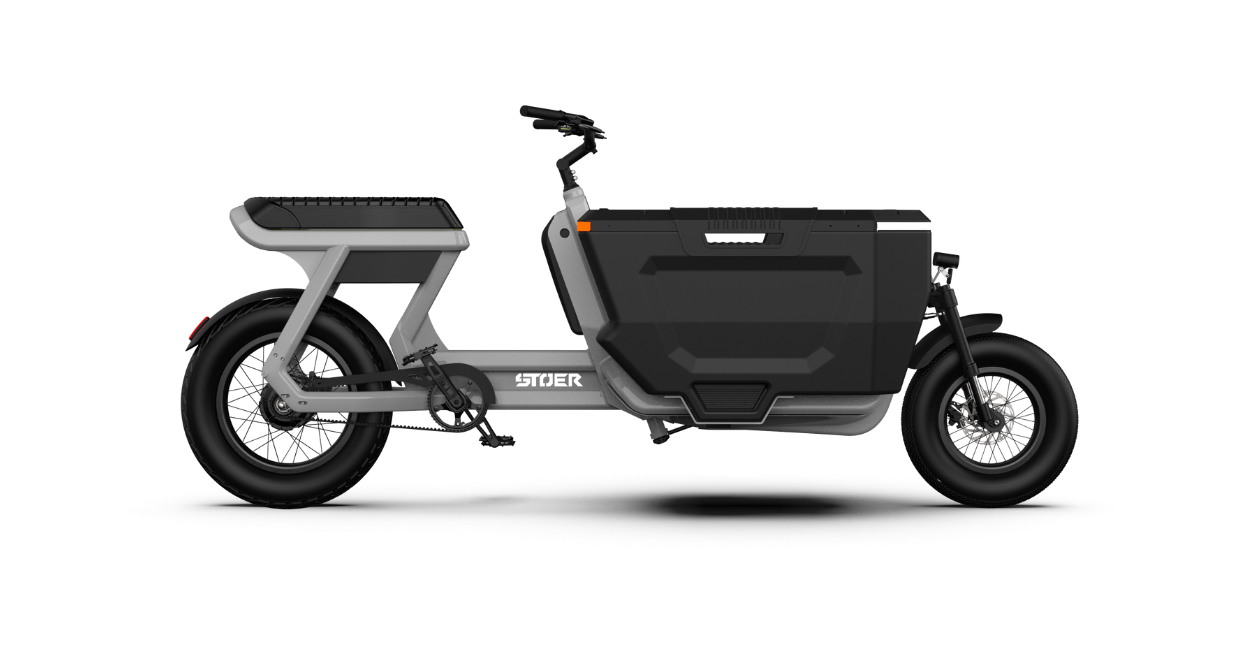
- The STOER CargoX: an example of a complete cargo bike
- Summary
- Frequently asked questions about buying an electric cargo bike
Who is an electric cargo bike suitable for?
An electric cargo bike is not the best choice for everyone. It is an investment that will pay for itself if you use it regularly. The question is: Does a cargo bike fit your life?
Families with young children
Most electric cargo bikes are bought by families with children between 0 and 8 years old. You can transport children safely in the cargo box, protected from wind and weather. The school run, grocery shopping, going to daycare - everything is faster than using the car in the city. No parking hassles, no traffic jams, no gasoline costs. A cargo bike with room for 2 to 4 children is ideal then.
Entrepreneurs and businesses
More and more companies are discovering the cargo bike for business transportation. Think package deliverers, caterers, florists or plumbers. You get everywhere, including car-free inner cities and zero-emission zones. Operating costs are a fraction of a van. For business use, pay attention to payload, bucket size and sturdiness.
People who want to replace the car
An electric cargo bike can replace the second car. For trips up to 15 kilometers, the cargo bike is often faster than the car, especially in urban areas. You save on fuel, insurance, road tax and parking costs. The payback period of a cargo bike compared to a car is often around 2 to 3 years.
Want to know more about the comparison between cargo bike and car? Check out our STOER Bikes blog for more articles.
Two wheel or three wheel cargo bike: what do you choose?
The first choice you make is between a two-wheel and a three-wheel cargo bike. Both types have advantages and disadvantages.
Two wheel cargo bike
A two-wheel cargo bike has one wheel in the front and one wheel in the back, with the box in between. This type rides most like a regular bicycle. You lean into turns and the steering feels familiar. Two-wheelers are more maneuverable and often narrower, which is useful on narrow bike paths.
The downside is that you have to keep your balance at a standstill. With heavy loads or busy children, this can be tricky. Most people get used to this quickly, but it takes some practice.
Three-wheel cargo bike
A three-wheel cargo bike has two wheels in the front (under the body) and one wheel in the back. The big advantage is stability at standstill. You can let go of the bike without it falling over. This is nice when loading and unloading children or heavy cargo.
The downside is the handling. A tricycle does not lean into corners, which feels uncomfortable. You have to actively turn the handlebars into the corner. The turning radius is larger and the bike is wider, which can be tricky on narrow paths.
Which one do you choose?
For most families, a two-wheel cargo bike is the best choice. It rides more pleasantly and is more maneuverable. A tricycle is a better fit if you often carry heavy or unstable loads, or if you have trouble keeping balance. Try both types on a test ride before you decide.
The motor: the heart of your electric cargo bike
The engine determines how your cargo bike rides. There are big differences in power, smoothness and reliability. What should you look for?
Motor power and torque
Electric bikes in Europe legally have a maximum power of 250 watts. This applies to all brands. But power doesn't say everything. Torque, expressed in Newton meters (Nm), determines how strongly the motor pulls. With a cargo bike with a heavy load, this is important.
An engine with 50 to 60 Nm of torque is sufficient for flat terrain with light loads. For hills or heavy loads, you want at least 80 Nm. The STOER CargoX has an engine with 92 Nm of torque, allowing you to accelerate smoothly even with 150 kilograms of load.
Middle motor or hub motor?
There are two types of motors: center motors and hub motors. A center motor sits near the bottom bracket, in the middle of the bike. A hub motor sits in the front or rear wheel.
For cargo bikes, a center motor is often the better choice. The weight is low and central, which improves balance. The motor works together with the gears, giving you the right support at any speed. With a hub motor, you miss that advantage.
Automatic or manual shifting?
Some bikes have an automatic shifting system. The gears adjust based on your speed and pedaling power. You don't have to think about shifting gears, which makes riding easier. The Bafang H720 motor in the STOER CargoX has such an automatic 2-speed gear system. You always start in the right gear, even on an incline.
Manual shifting gives more control, but requires attention. For daily use with children, automatic shifting is often more comfortable.
The battery: range and lifetime
The battery determines how far you can drive on one charge. But there is more to consider than just capacity.
Battery capacity in watt-hours
Battery capacity is expressed in watt-hours (Wh). The higher the number, the more energy the battery can store. A 500 Wh battery will get fewer miles than a 960 Wh battery. For cargo bikes with heavy loads, you want at least 600 Wh, preferably more.
The STOER CargoX has a 960 Wh battery, good for 60 to 100 kilometers of range depending on load and riding style. That's enough for a week's commute without recharging.
Factors affecting outreach
The range given is an indication, not a guarantee. Many factors influence how many kilometers you get:
The weight of rider and load plays a big role. The heavier, the more the motor has to work and the faster the battery drains. Wind and hills also cost energy. On a windy day with a headwind, you will get fewer miles than on a windless day. The assistance level counts. On the highest setting, you use more energy than on a low setting. Finally, temperature matters. In winter, a battery performs worse than in summer.
Charging time and lifetime
Fully charging an empty battery takes 4 to 8 hours, depending on capacity and charger. Most people charge overnight. A removable battery is handy if you don't have an outlet at your storage facility. You take the battery out and charge it inside.
Batteries do not last forever. After 500 to 1,000 charge cycles, capacity decreases. With daily use, it is 3 to 5 years. A replacement battery costs €400 to €800. Factor that cost into your budget.
Want to know more about battery maintenance? Read our article on cargo bike maintenance.
The bin: material, size and safety
The bin is where you carry children or cargo. There are major differences in material, size and safety features.
Baking equipment
Bins are made of wood, plastic, aluminum or EPP. Each material has advantages and disadvantages.
Wooden containers look beautiful and feel warm. They are heavier, though, and require maintenance with oil or varnish. Plastic containers are lighter and low-maintenance, but sometimes less sturdy. Aluminum is strong and light, but conducts heat, making the bin hot in summer and cold in winter.
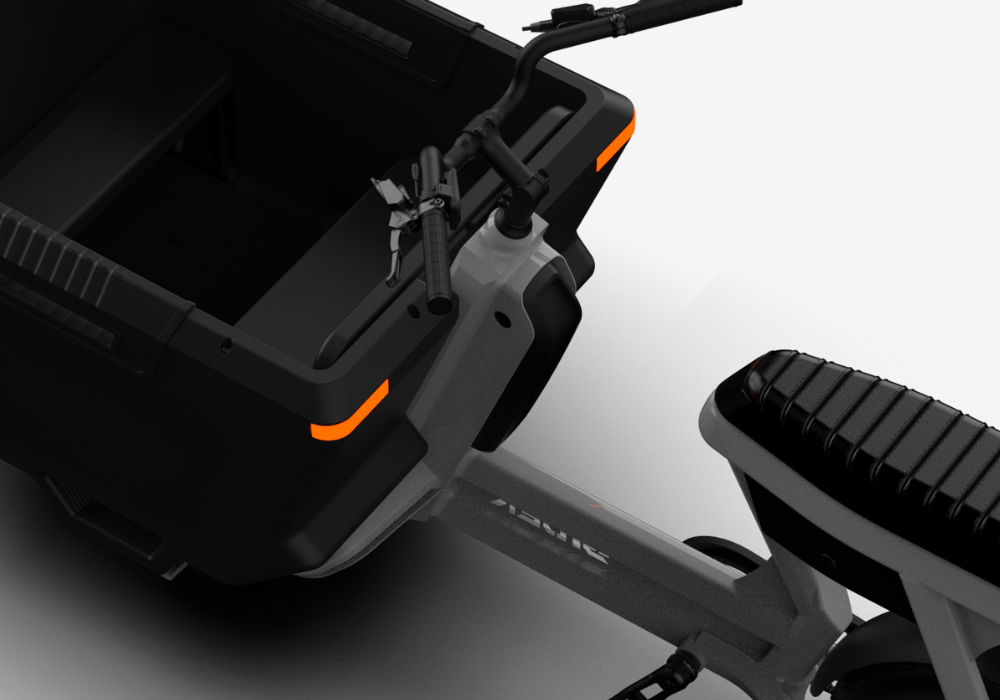
EPP (Expanded Polypropylene) is a newer material that is becoming increasingly popular. It is light, strong, shock absorbent and fully recyclable. The STOER CargoX has an EPP container measuring 100×70 centimeters. The material does not absorb water, does not rot and requires no maintenance.
Tray size and capacity
The bin size determines how much you can carry. Don't just measure the inside dimensions; look at the maximum payload in kilograms. A large bin with low payload is of limited use.
For 2 children, an 80×60 centimeter bin is sufficient. For 3 or 4 children, you need at least 100×70 centimeters. The CargoX offers space for 2 to 4 children depending on age, with a maximum load capacity of 150 kilograms.
Safety features
When transporting children, safety is the priority. Pay attention to these points:
Seat belts must be sturdy and meet European standards. Two- or three-point belts keep children in place, even during an emergency stop. High sidewalls protect against falling out of the bin. A container at least 40 centimeters high is recommended. Some cargo bikes have a safety bar with rain cover that provides additional protection.
Review the safety features of the STOER CargoX on the product page.
Drive: chain or belt?
The drivetrain transfers power from the motor and pedals to the wheel. There are two systems: chain and belt.
Chain drive
The traditional bicycle chain is well known and proven. Any bike shop can repair or replace a chain. The downside is maintenance. A chain needs regular lubrication and wears out relatively quickly. With heavy use, replace a chain every 2,000 to 5,000 kilometers. Chains can also fall off or break.
Belt drive
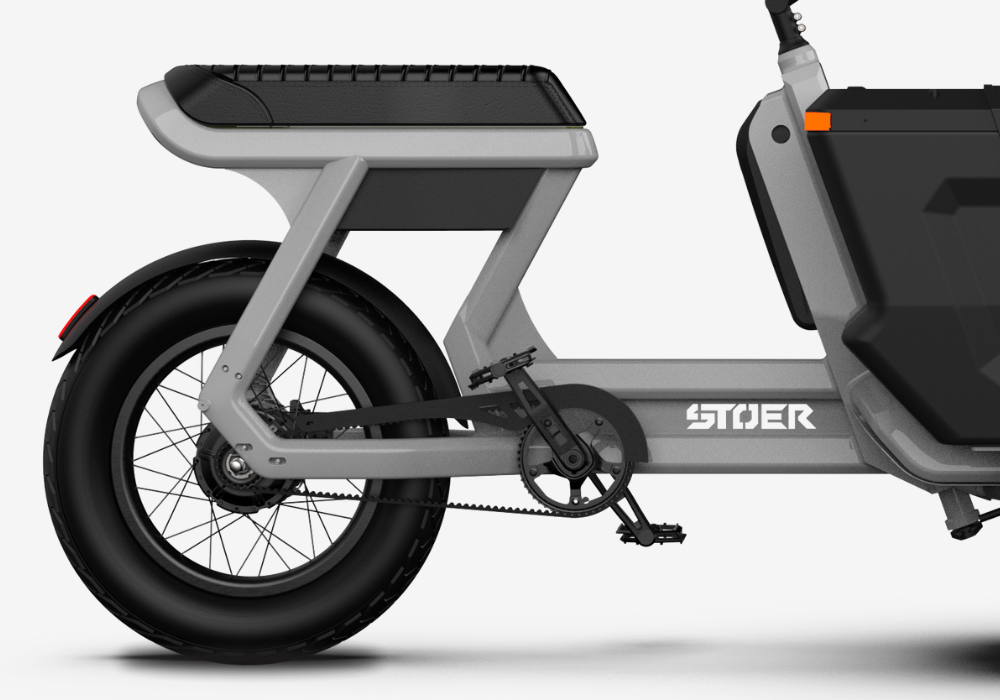
A belt drive system uses a carbon belt instead of a metal chain. The Gates CDX is the best-known system and is used by STOER Bikes, among others. The advantages are many.
A belt requires no lubrication and is maintenance-free. You won't get dirty hands or stains on your clothes. The belt is quieter than a chain, which is nice with children in the tub. It lasts 3 to 5 times longer than a chain. A belt lasts 15,000 to 30,000 kilometers under normal use. The belt does not rust and is resistant to all weather conditions.
The downside is that not every bike shop can replace belts. You have to rely on dealers who work with the system. The purchase cost is slightly higher, but you recoup that through lower maintenance costs.

Brakes and suspension: comfort and safety
With a cargo bike, you ride with more weight than on a normal bike. That puts demands on brakes and suspension.
Hydraulic disc brakes
For cargo bikes, hydraulic disc brakes are the standard. They offer plenty of braking power with little hand force, even in wet weather. Mechanical rim brakes are not strong enough to safely stop a loaded cargo bike.
Pay attention to the disc diameter. Larger discs (180 mm or more) brake better than smaller discs. The STOER CargoX has Tektro hydraulic disc brakes with integrated brake lights. These light up as soon as you brake, alerting traffic behind you.
Suspension for comfort
A cargo bike without suspension is hard and uncomfortable, especially for children in the cargo box. Front suspension catches bumps and potholes. Some cargo bikes also have suspension in the cargo box itself.
The CargoX has front wheel suspension that provides a smooth ride over bumps and curbs. Children feel fewer jolts, making long rides more enjoyable.
Tires: narrow or wide?
The tires determine grip, comfort and safety. With cargo bikes, there is an important choice: standard tires or thick tires.
Standard tires
Most cargo bikes have tires 2 to 2.5 inches wide. These tires roll lightly and are sufficient for normal conditions. On slippery roads or in rain, they offer less grip than wider tires.
Thick (fatbike) tires
Some cargo bikes, such as the STOER CargoX, have extra-thick tires 4 inches wide. These fatbike tires have great advantages for cargo bikes.
Grip is better on all surfaces, including rain, snow or loose tiles. Stability increases, especially with heavy loads. Comfort improves because the tires absorb shocks. And a big advantage in cities: thick tires don't get stuck in streetcar rails. This is a well-known safety risk with narrow tires.
The disadvantage is that thick tires roll a little heavier. With an electric cargo bike with a strong motor, you hardly notice it.
"We have been riding a Stoer bicycle for a year now without any problems. Even the battery capacity has not deteriorated. And when you then see other brands where after a year the rust marks are visible I am glad I spent a little more and now have a bike made entirely of aluminum. And this one stays really neat!!!"

What are the main conclusions about the weight difference between drive systems?

"Purchased a STOER Bike last year after trying several fatbikes. STOER is by far the best! Still very much enjoy my purchase. In addition, the service is top notch!"

"The bike is perfect for people with long legs. Sitting comfort is perfect for long distances."

Lighting and visibility
A cargo bike is larger than a normal bicycle. In traffic, you want to be highly visible, especially in the dark.
Lighting
Good lighting is mandatory and life-saving. Choose LED lights powered by the battery. It never goes out and does not need to be recharged. Pay attention to front and rear lights, as well as reflectors on the side.
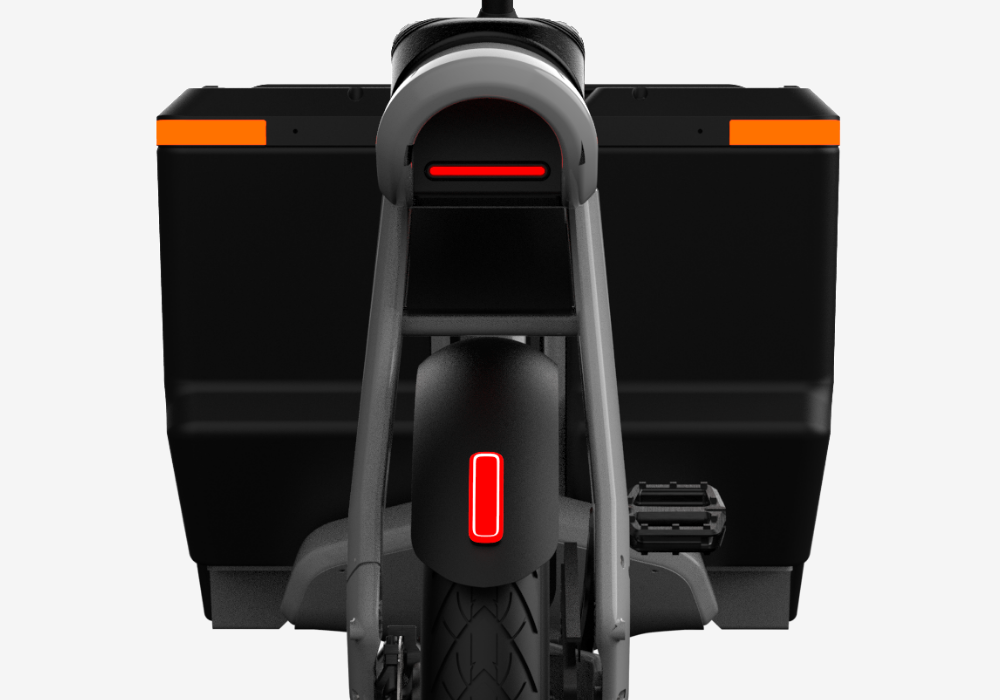
Some cargo bikes have additional features such as daytime running lights and brake lights. Daytime running lights also make you more visible during the day. Brake lights warn traffic behind you when you brake. The STOER CargoX has both.
Indicators
A unique feature on some cargo bikes are turn signals, just like a car. You signal when you turn or change lanes without taking your hand off the handlebars. This is safer and clearer for other road users. The CargoX has integrated turn signals in the body.
Security against theft
An electric cargo bike is an expensive purchase and, unfortunately, popular with thieves. Good security is necessary.
Lock
Always use a good lock, at least ART-2 approved. A chain lock or shackle lock is stronger than a cable lock. Secure the cargo bike to a fixed object such as a bicycle staple or lamppost.
Built-in security
Some cargo bikes have built-in security features. A PIN code immobilizer ensures that the bike will work only if you enter the correct code. Without a code, a thief cannot electrically drive the cargo bike away.
GPS tracking makes it possible to track your cargo bike if it is stolen. The police can use the location to find the bike. The STOER CargoX has both PIN code security and GPS tracking built in as standard.
Secured
Cargo bike insurance covers theft, damage and sometimes breakdown on the road. Pay attention to the conditions: is there a deductible for theft? Is the new-for-old value or the current value reimbursed? How long does the new-for-old coverage apply?
STOER Bikes offers its own insurance with 3 years new-value coverage and no deductible for theft. Check out the possibilities on the insurance page.
Price and what you pay for
Electric cargo bikes cost between €3,000 and €8,000. That's a wide range. Where is the difference?
Budget cargo bikes (€3,000 - €4,500)
In this segment you will find entry-level models. The motor is often less powerful (50-60 Nm), the battery smaller (400-500 Wh) and the finish simpler. For occasional use or short rides, this may be sufficient. Do pay attention to warranty and service, as cheap models sometimes have limited support.
Middle segment (€4,500 - €6,500)
Here you will find cargo bikes with better motors, larger batteries and more safety features. The materials are sturdier and the warranty is often more extensive. For everyday use, this segment is the best choice.
Premium segment (€6,500 - €8,000+)
Premium cargo bikes have the best specifications: strong motors (80-100 Nm), large batteries (800-1000 Wh), belt drive, high-quality brakes and extensive security. The finish is perfect and the warranty generous. The STOER CargoX (€6,495) falls into this segment with 92 Nm motor, 960 Wh battery and Gates CDX belt drive.
Total cost of ownership
The purchase price is not the whole story. Also factor in maintenance costs, insurance and any repairs. A belt-driven cargo bike is more expensive to buy but cheaper to maintain. Good insurance costs €15 to €30 per month. Over 5 years, the total cost of a cheap cargo bike with lots of maintenance may be higher than a more expensive cargo bike that requires little attention.
Test drive: why you should
You don't buy an electric cargo bike based on specifications alone. You have to experience it. A test ride is indispensable.
What you test during a test drive
During the test drive, pay attention to several things. How does the steering feel? Is the motor smooth or jerky? How responsive is the support? Can you reach the controls easily? Are you comfortable? How does the cargo bike ride when cornering?
Take children with you if you are going to transport them. That way you will notice how the cargo bike rides with cargo. Ask if you can ride up an incline to test the bike.
Where to take a test drive
Most cargo bike brands sell through dealers. At a dealer you can try different models and get advice. STOER Bikes has a network of dealers throughout the Netherlands, Belgium and Germany. Check the overview on the dealer page and schedule a test drive.
Checklist: what do you pay attention to when buying?
Use this checklist when shopping for an electric cargo bike:
Determine your budget including accessories and insurance. Choose between two-wheel or three-wheel. Check engine power and torque (at least 80 Nm for heavy loads). Check battery capacity and specified range. Look at the bucket material and safety features. Compare chain and belt drives. Note brake type (hydraulic disc brakes are the standard). Ask about tire width and whether they are suitable for streetcar rails. Check lights, turn signals and reflectors. Ask about built-in security such as GPS and PIN code. Compare warranty terms. Inquire about service and maintenance network. Always take a test drive before buying.
The STOER CargoX: an example of a complete cargo bike
To make concrete what you look for, let's take the STOER CargoX as an example. This cargo bike won the German Design Award 2025 and combines all the features we discussed.
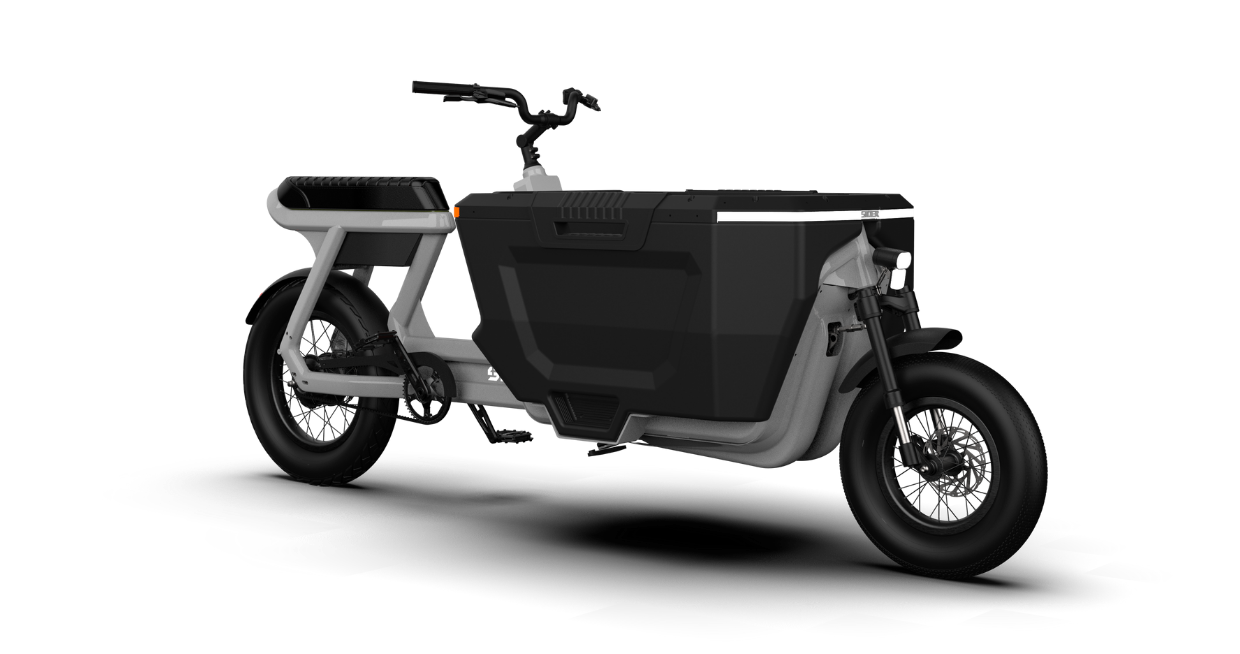
The motor is a Bafang H720 with 92 Nm of torque and automatic 2-speed transmission. This is sufficient for hills and heavy loads. The battery has 960 Wh capacity for 60-100 kilometers of range. The 100×70 cm EPP bucket provides space for 2-4 children with 150 kg payload. The Gates CDX belt drive is maintenance-free. Tektro hydraulic disc brakes with brake lights ensure safe stopping. Thick fatbike tires (20×4 inch rear, 16×4 inch front) provide grip and won't get stuck in streetcar rails. Turn signals, daytime running lights and GPS tracking are standard. Warranty is 2 years on engine and moving parts, 5 years on frame.
"We designed the CargoX for people who rely on cargo bikes every day," says Thomas, co-founder of STOER Bikes. "Everything has to work, every day, without fuss. That means a strong motor, big battery and parts that don't require maintenance."
Summary
Buying an electric cargo bike requires good preparation. First determine if a cargo bike suits you and what you will use it for. Choose between two-wheel or three-wheel, compare motors for torque and batteries for capacity. Pay attention to cargo equipment, safety features and drive train. Hydraulic disc brakes and good lighting are essential. Security with GPS and PIN code protects against theft. Look beyond the purchase price and factor in total cost of ownership. And always take a test drive before you decide.
Ready to get started? Check out the STOER CargoX or plan a free test drive at a dealership.
Frequently asked questions about buying an electric cargo bike
What does an electric cargo bike cost?
Electric cargo bikes cost between €3,000 and €8,000. Entry-level models start around €3,000, while premium cargo bikes with powerful motors, large batteries and belt drive cost €6,000 to €8,000. The STOER CargoX costs €6,495.
How far do you get on an electric cargo bike?
The range depends on battery capacity, load and driving style. A 500 Wh battery reaches 40-60 kilometers, a 960 Wh battery reaches 60-100 kilometers. Wind, hills and support level affect the range.
Is an electric cargo bike hard to ride?
Most people get used to a cargo bike within 30 minutes. Steering is different because the cargo box is in front of you, but your brain adapts quickly. A test ride helps discover what it feels like.
How many children fit in a cargo bike?
It depends on the bin size and the age of the children. Most cargo bikes offer space for 2 children. Larger models such as the STOER CargoX offer space for 2-4 children depending on age and size.
Should I insure a cargo bike?
Insurance is not mandatory but is recommended. An electric cargo bike is an expensive purchase that is of interest to thieves. Good insurance covers theft, damage and sometimes breakdown along the way.
Which is better: chain or belt?
A belt drive is maintenance-free, quieter and lasts longer than a chain. You don't get your hands dirty and the belt doesn't rust. The downside is that not every bike shop can replace belts. For daily use, a belt is the better choice.
Where can I take a test drive?
Most brands sell through dealers where you can take a test ride. STOER Bikes has dealers in the Netherlands, Belgium and Germany. See the overview at stoerbikes.com/dealers.


